Your teenager is practising drums. Your partner is on a conference call. The dog has opinions about the postman. And somehow, every sound in your house seems to travel through every door like they’re made of tissue paper.
That’s because most of them basically are. The standard hollow-core internal doors fitted in the majority of UK homes weigh next to nothing and block almost no sound. They’re fine as room dividers, but they’re terrible at privacy, noise control, or giving anyone in the house a genuine quiet space.
Enter the acoustic door — also known as a soundproof door. It sounds specialist and expensive, but it doesn’t have to be either. At Durajoin, we supply soundproof internal doors and acoustic doors alongside every other door type in our range. This guide explains what actually makes a door “acoustic-grade,” how dB ratings work in plain English, and — most importantly — whether you actually need one.
First: What Does "dB" Actually Mean?
Decibels (dB) measure sound pressure. The scale is logarithmic, which means a 10dB increase doesn’t sound “a bit louder” — it sounds roughly twice as loud. Here’s a quick reference so the numbers mean something:
When a door is rated at, say, 33dB, that means it reduces sound passing through it by 33 decibels. So a 70dB vacuum cleaner on the other side would sound like a gentle 37dB murmur — barely noticeable. That’s the difference between “I can hear every word” and “I didn’t even know anyone was home.”
What Makes a Door Acoustic-Grade?
An acoustic door isn’t just a thicker version of a normal door. It’s an engineered system — the door leaf, the frame, the seals, and the threshold all work together to block sound. According to ENVO, acoustic-rated doors must be manufactured and installed as a complete doorset — a standalone door leaf won’t achieve its lab-tested rating without the matching frame and seals.
Here’s what separates an acoustic door from a standard one:
- Solid, dense core — Acoustic doors use high-density particleboard, MDF, or multi-layered timber cores rather than the hollow or lightweight cores in standard interior doors and internal doors. More mass = more sound blocked. The heavier the door, the better it performs.
- Acoustic seals around the frame — Rubber or neoprene compression seals fitted into grooves around the top and sides of the frame. When the door closes, these seals compress to create an airtight barrier. Without them, sound leaks around the edges regardless of how dense the door itself is.
- Drop-down threshold seal — The gap at the bottom of the door is the biggest sound leak. Acoustic doors use an automatic drop-down seal that lowers when the door closes and lifts when it opens, sealing the gap without dragging on the floor.
- Tight tolerances — The gap between door and frame must be consistent and minimal (typically 2–3mm) for the seals to work. A poorly hung door with uneven gaps won’t perform, even with acoustic seals fitted.
- Tested and rated — Genuine acoustic doors are laboratory-tested to a specific Rw (weighted sound reduction index) rating. Common residential ratings range from 29dB to 45dB. Anything marketed as “soundproof” without a tested dB rating should be treated with scepticism.
Do You Actually Need One? The Honest Quiz
When a door is rated at, say, 33dB, that means it reduces sound passing through it by 33 decibels. So a 70dB vacuum cleaner on the other side would sound like a gentle 37dB murmur — barely noticeable. That’s the difference between “I can hear every word” and “I didn’t even know anyone was home.”
Score yourself: does your home need acoustic doors?
- Someone works from home and needs quiet for calls or concentration
- A musician practises at home (any instrument — even “just guitar”)
- You live in a flat, HMO, or converted property with thin walls
- Teenagers with different sleep schedules and loud music taste
- A home cinema or media room where you want to contain bass
- A bedroom next to a noisy kitchen, utility room, or busy hallway
- You’ve tried closing the door and can still hear full conversations
- Night-shift workers who sleep during the day
If two or more apply: acoustic doors will make a measurable, daily difference to your quality of life. If none apply, standard solid-core doors from Durajoin will likely be sufficient — they still block significantly more sound than hollow-core doors.
The Ratings: What Do You Actually Need?
- 29–31 dB — Entry-level acoustic. A solid-core door with basic seals. Enough to muffle conversation and reduce general household noise. Good for bedrooms and home offices in average-noise homes.
- 33–35 dB — Mid-range. Noticeably quieter. Voices become indistinct murmurs. Suitable for most residential applications where genuine privacy matters — home offices, nurseries, and bedrooms adjacent to living areas.
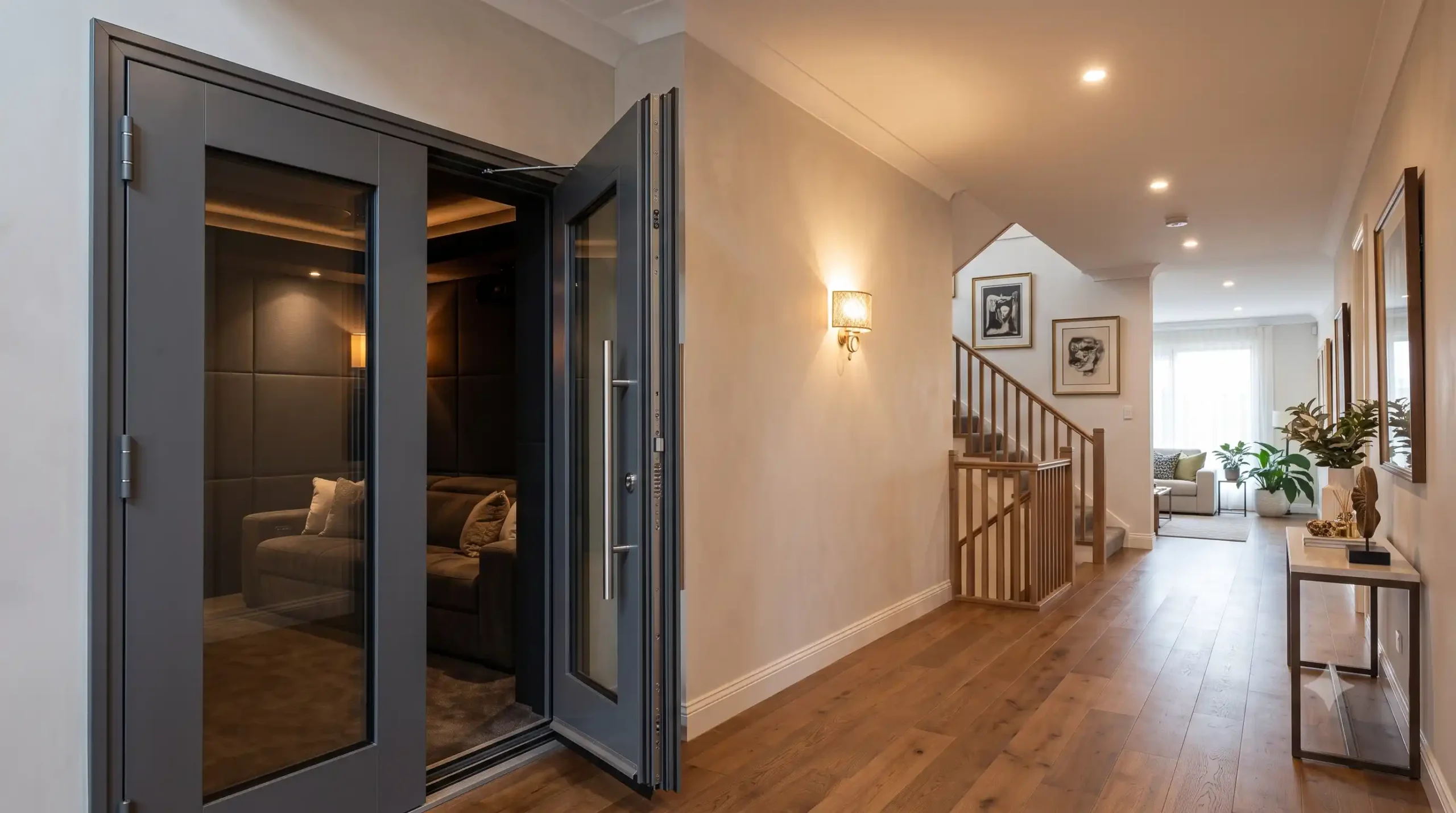
- 38–45 dB — High-performance. Near-silence on the other side. Required for music rooms, home studios, cinema rooms, and any space where containing significant sound is essential. These are specialist doors and come at a premium price.
Durajoin supplies acoustic doors across the full range — from affordable solid-core upgrades that make an immediate difference, through to high-performance 44dB doorsets for serious sound control. Every acoustic door we supply comes as a complete system: door leaf, frame, seals, and drop-down threshold, because anything less won’t achieve the rated performance.
Acoustic Doors for Every Room and Situation
Durajoin supplies acoustic versions across our full interior door range — because noise doesn’t only come from one direction:
- Internal doors and interior doors — Panelled doors, flush doors, louvre doors (not great for sound — open slats leak noise), pocket doors (poor acoustic performance unless specially sealed), barn doors interior (limited sound blocking due to gaps), pivot doors, glass doors (acoustic-rated laminated glass available).
- Fire doors — FD30 fire door and fire rated internal doors are inherently dense and, with acoustic seals added, deliver respectable sound reduction. Fire door cost is modest, and you get safety and sound control in one product.
- Black doors interior design — Acoustic doors are available in every finish, including the matt black that’s currently one of the most popular interior trends. Best internal doors UK from Durajoin.
- Bathroom door ideas — An acoustic door with obscure glass or frosted glass internal door panel provides both privacy and sound reduction for bathrooms adjacent to living spaces.
- Child safe door lock and finger guard doors — Safety features compatible with acoustic doors for families.
- Soundproof internal doors and acoustic doors — The dedicated high-performance range for studios, cinema rooms, and music practice spaces.
What About External Doors?
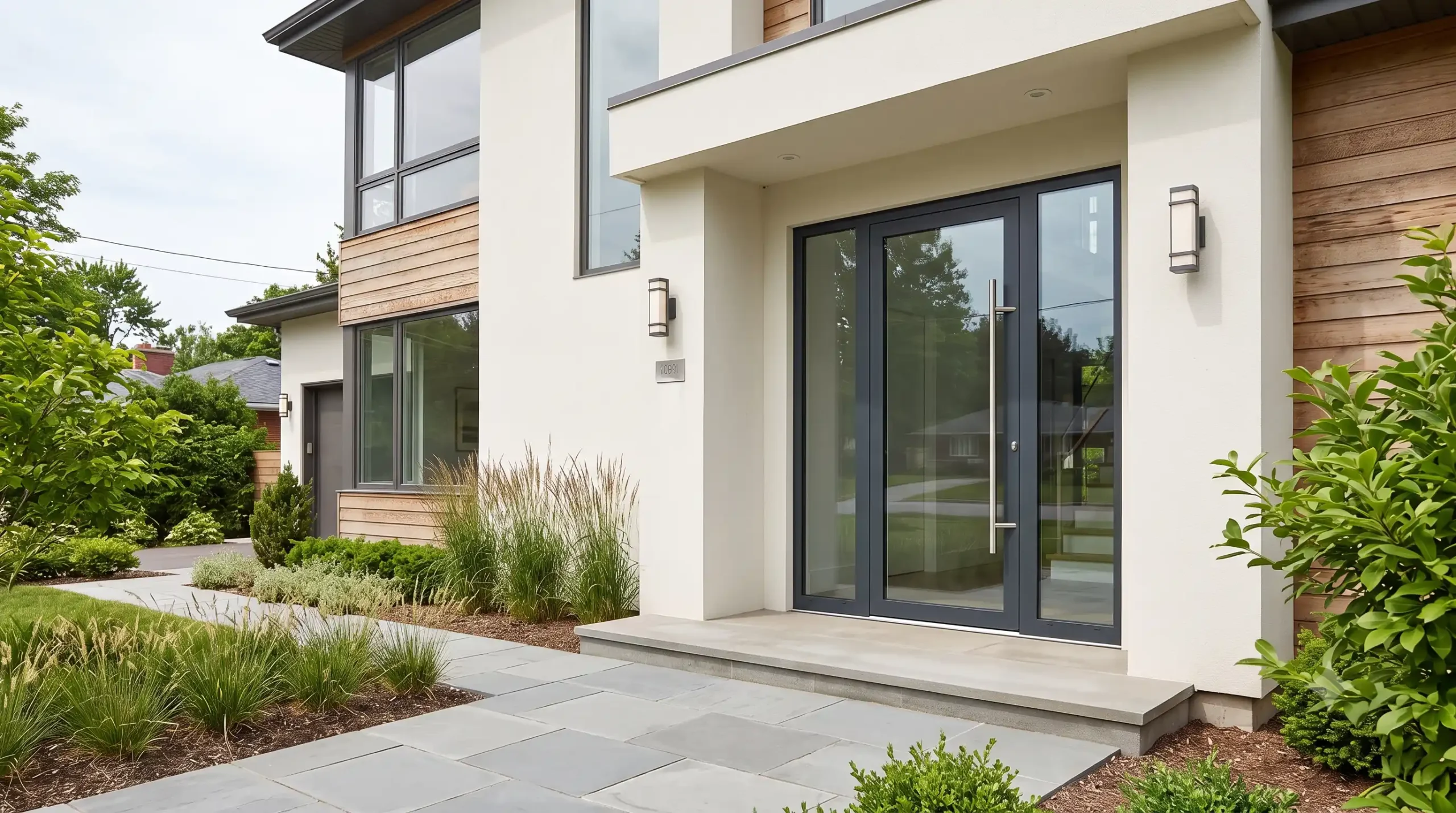
External doors block outside noise — traffic, neighbours, road works, the dawn chorus at 4am in June. A well-sealed, high-quality front door inherently provides significant sound reduction. Durajoin’s composite doors, composite entrance doors, aluminium doors, timber doors, wooden doors, uPVC doors, and steel doors all deliver meaningful noise reduction as standard — and can be specified with acoustic-grade seals and thresholds for homes on busy roads or near airports.
For maximum external noise reduction: a steel double front doors or modern double front doors unit with laminated acoustic glass, multi-layer seals, and a drop-down threshold will deliver the highest performance. Fibreglass doors also perform well. Composite door vs uPVC door for sound? Composite’s denser core blocks more noise. Wooden door vs composite door? Similar performance when both are solid-core. Is a composite door better than uPVC? For acoustics, yes. Most secure front door material? Composite and steel. Best material for front door sound reduction? Composite with acoustic seals.
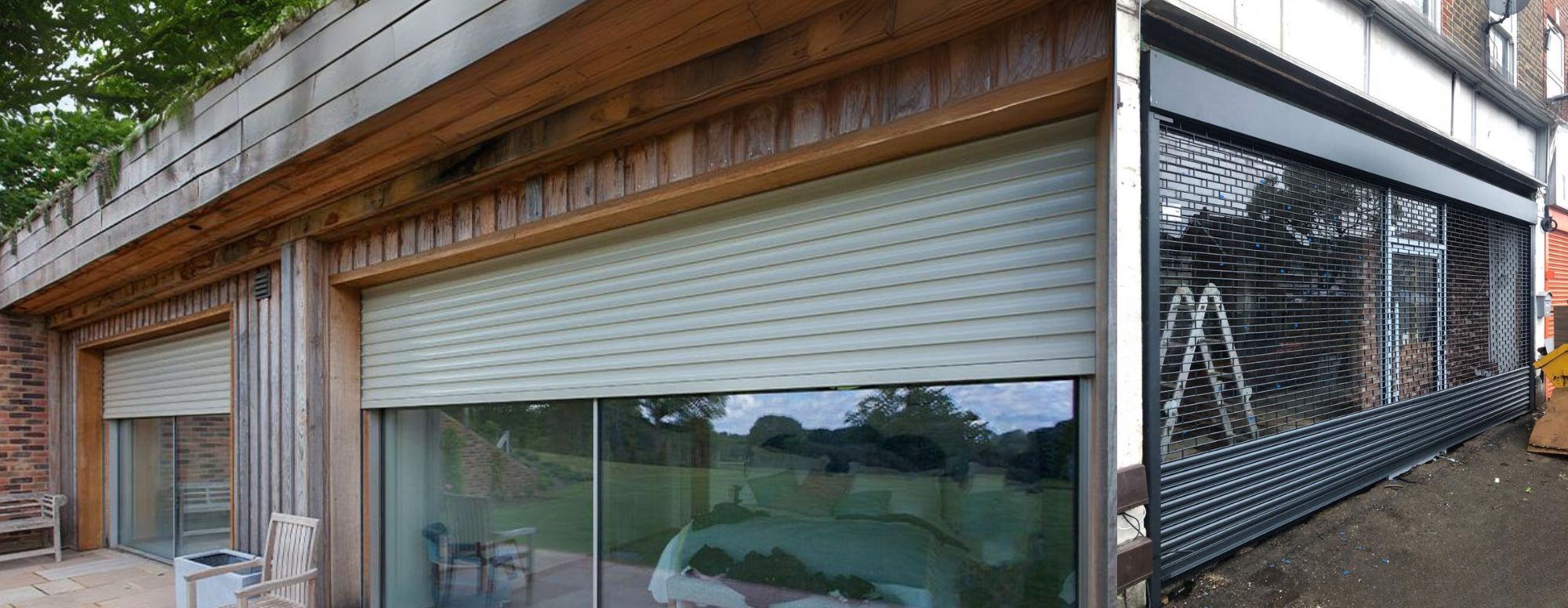
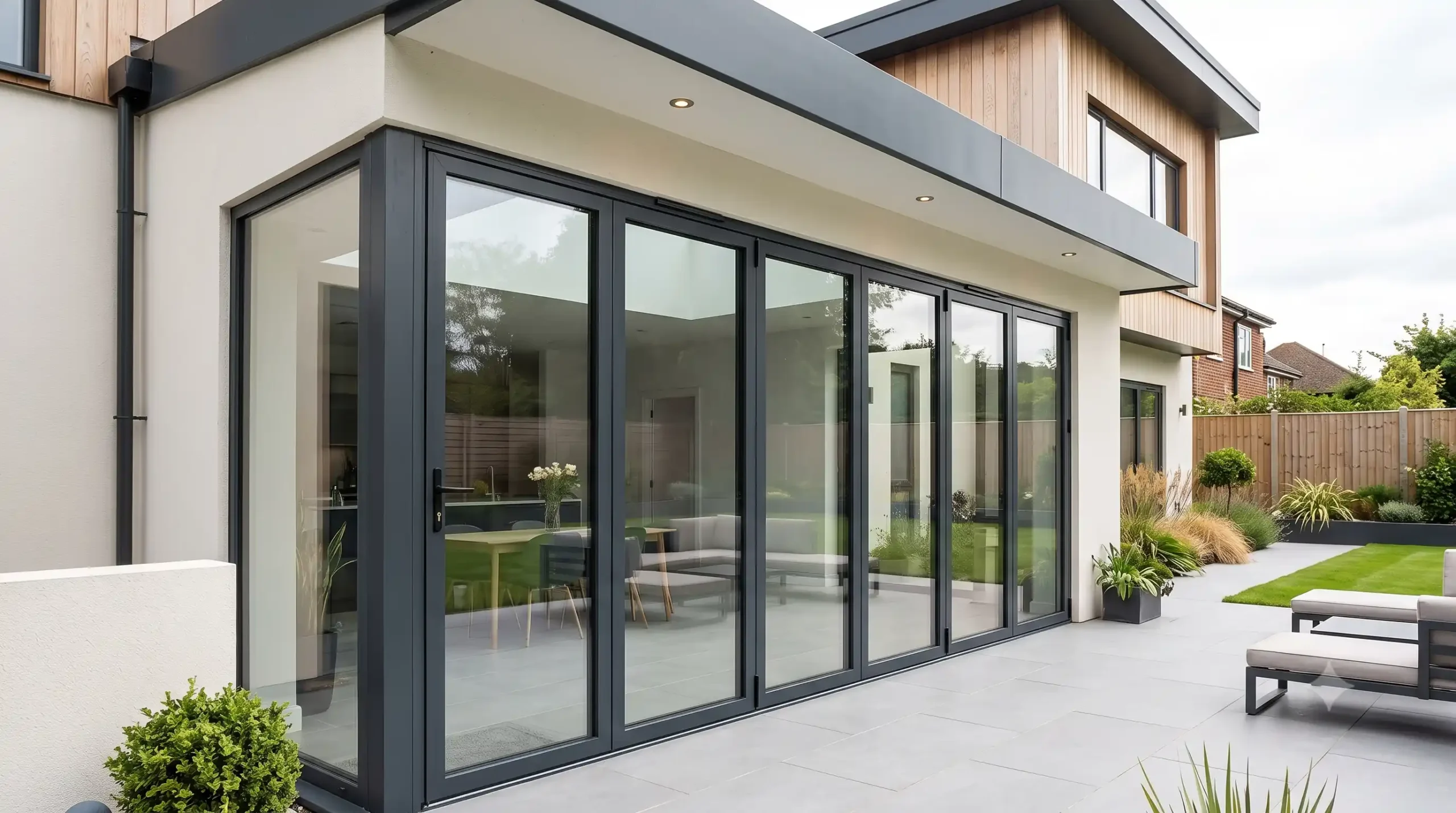
Other exterior doors also contribute to your home’s overall sound environment. French doors and French double front doors with laminated glass outperform standard double glazing for noise. Do French doors open inwards or outwards? Both configurations from Durajoin, with acoustic seals on each. Patio doors and sliding patio doors benefit from acoustic interlayers in the glass. Bifold doors and bi-folding doors have more panel joints (potential sound leaks), but quality seals minimise this. Are bifold doors worth it? For views and space, absolutely — just don’t expect studio-level silence when they’re closed. Garage doors, roller shutter doors, and their mechanisms can transmit vibration; garage door installation with acoustic consideration matters if your garage shares a wall with a living space.
Style, Colour, and Kerb Appeal
Acoustic doors don’t have to look clinical. Durajoin supplies them in every interior finish and offers external doors in the full spectrum of front door colour ideas: anthracite grey front door, black composite door, contemporary front door, modern front door design, Victorian front door, cottage style front door, farmhouse front door, traditional front door styles. What is the most popular front door colour? Anthracite grey. Best front door colours 2025 carry into 2026. Dual colour composite door, woodgrain effect door, flush fit front door, obscure glass front door, front door with glass panels, door with stained glass, entry door with decorative glass, frosted glass internal door, Georgian bar door, door knocker designs, front door hardware styles, door handle styles, letterbox for composite door. How much value does a new front door add? Estate agents rank it among top kerb appeal investments.
Energy, Security, and Smart Tech
Energy efficient front doors, insulated exterior doors, thermal front door, triple glazed door, argon gas filled doors, most energy efficient door material, door U-value explained (lower is better), door energy rating A, energy rated doors, warm edge spacer bar doors, draught proof front door, front door draught excluder, government grants for doors. How to stop condensation on front door? Proper thermal performance and seals.
Security: most secure front door, anti snap lock doors, multipoint locking door, Secured by Design doors, PAS 24 doors, smart door lock UK, smart lock front door, keyless entry door, wifi door lock, fingerprint door lock, video doorbell compatible doors, reinforced door frame, laminated glass door, door chain vs deadbolt, burglar proof front door, door security upgrades, security doors residential, automatic door opener residential, remote control garage door, smart patio door lock.
Every Door Type from Durajoin
Buy front door, front doors for sale, new front door, replacement doors, entry doors, exterior doors, external doors, interior doors, internal doors, back door replacement, side door for house. French double front doors, modern double front doors, double doors exterior, door with sidelights, door with transom, door with fanlight, contemporary front door. Stable doors, Dutch doors, storm doors, screen doors, cat flap doors, pet doors, wheelchair accessible doors, wide doors for disability access, flood resistant doors, doors for coastal areas, kitchen to garden doors, conservatory doors, doors for extensions. Bifold doors cost, bifold doors cost per metre, what width bifold doors for 3m opening, aluminium bifold doors vs uPVC. Sliding patio door prices UK. Garage doors near me, garage door replacement cost, garage door repairs. How long do composite doors last? 30+ years. Do composite doors fade in the sun? Barely. Can you paint a composite door? Yes, rarely needed. Composite door cracking? Extremely rare. Fibreglass door vs wood door? Fibreglass is lower maintenance. Steel door vs fibreglass door? Steel for strength. Longest lasting front door material? Aluminium 40+; timber 40–60+ with maintenance.
Costs, Sizing, and Getting Started
How much does a new front door cost? Composite door prices, cheap front doors, affordable exterior doors, budget internal doors — Durajoin quotes transparently. French doors price, patio door prices, sliding patio door prices UK, bifold doors cost per metre, garage door replacement cost, fire door cost, front door installation cost, door fitting cost, cost to replace internal doors. Door finance options, buy now pay later doors, door price calculator. Standard front door size UK, standard internal door sizes, non standard door sizes, metric door sizes, bespoke door sizes, door frame sizes explained, bifold door width calculator. How to measure for a new front door? Our surveyor handles it.
Installation, Regulations, and Guarantees
Door installation near me, door fitter near me, FENSA registered door installer, CERTASS door fitter, front doors near me, front door showroom near me, front doors for sale, composite doors near me, bifold doors near me, garage doors near me, door suppliers near me, doors near me — Durajoin covers it all.
Building regulations front door, Part Q door requirements, do I need planning permission for a new front door (usually not), do I need building regs for a new front door (yes — Part Q applies), does a new front door need building control sign off (FENSA covers it), listed building front door, conservation area door rules, which way should a front door open (inward standard), can you get a mortgage with a non standard door. How long to fit a front door? Half a day. How to fit a front door? Professional installation from Durajoin protects warranty. Removing old front door, DIY front door installation, bifold door installation guide, cost to fit interior doors. Every door includes a 10 year door guarantee, insurance backed guarantee doors, composite door warranty (or equivalent). Door guarantee transferable. Door warranty what does it cover? Materials, hardware, glazing, seals, installation.
Maintenance and Aftercare
How to fix a sticking door, how to repaint a front door, how to adjust a uPVC door, how to fix a dropped door, door handle broken how to fix, door hinge replacement, door seal replacement, composite door cracking, uPVC door lock mechanism replacement, wooden door restoration, front door draught excluder — Durajoin supports you for life. Best composite door brands UK, best bifold door brands, best internal doors UK, door company reviews — we welcome comparison.
Your Questions, Answered
Can I make my existing door more soundproof?
Yes — adding acoustic seals around the frame and a drop-down threshold seal can improve sound reduction by 5–7dB without replacing the door itself. But if your current door is hollow-core, the improvement will be limited. A solid-core replacement from Durajoin is the most effective upgrade.
What is the best front door for a Victorian house?
Timber with period detailing and BS3621 locks, or composite with woodgrain effect door finish. Victorian front door styles are a Durajoin speciality.
Do acoustic doors look different from normal doors?
Not at all. Durajoin’s acoustic doors are available in every finish — oak, walnut, white primed, painted, and contemporary veneers. You choose the look; the acoustic performance is hidden inside.
Are acoustic doors also fire-rated?
Many are. FD30 fire door rated acoustic doors combine sound reduction with 30-minute fire resistance — ideal for flats, HMOs, and three-storey homes where both are required. Durajoin supplies combined acoustic/fire-rated doorsets.
How much value does a new front door add?
Estate agents rank it among the top kerb appeal investments. A quality, well-sealed front door adds both visual impact and measurable property value.
Craving Quiet? Get Your Free Durajoin Quote
Whether it’s an acoustic door for your home office, a solid-core upgrade for bedrooms, or a complete doors and windows refresh, Durajoin provides expert advice, professional installation, and a guarantee you can trust. No jargon, no pressure — just a quieter, more comfortable home.